

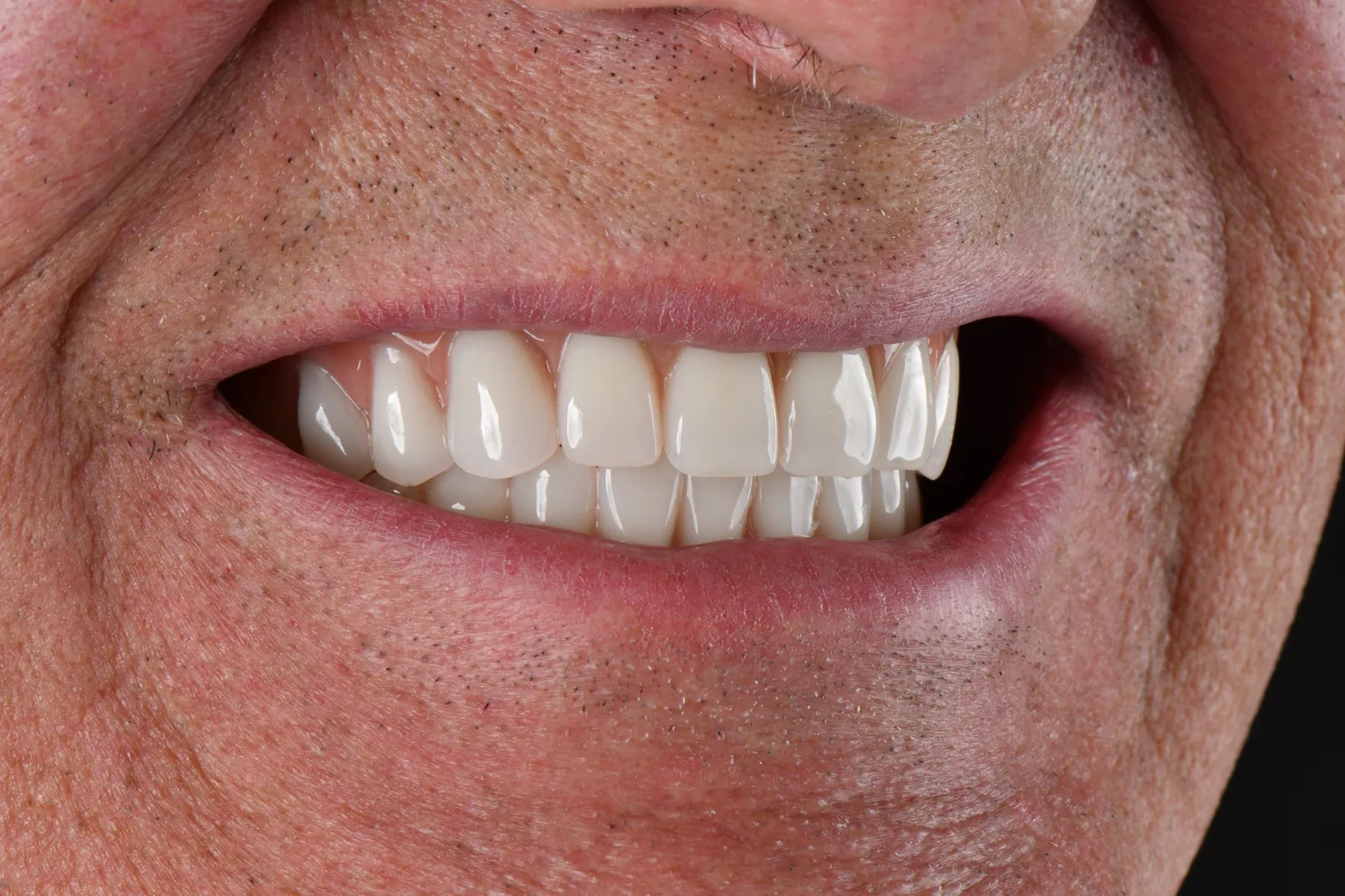
If you have lost most or all of your teeth in one jaw, a removable denture is no longer the only option. All-on-4 and All-on-6 both give you a fixed bridge supported by implants – often with temporary teeth on the very same day.
The main difference: number and angle of implants
All-on-4 uses four implants per jaw. The two rear implants are tilted up to 45° so that they anchor in dense bone and avoid the sinus (upper jaw) or the nerve canal (lower jaw). This is why All-on-4 works even when bone volume is limited and often makes bone grafting unnecessary.
All-on-6 uses six implants placed more vertically. The load is spread over more implants, which increases stability, reduces stress on each implant and makes the bridge easier to repair if one implant ever fails. It requires slightly more bone in the back of the jaw.
Which one do we recommend?
- Limited bone, wish to avoid grafting, budget-conscious: All-on-4.
- Sufficient bone, heavy bite, bruxism, wish for maximum long-term safety: All-on-6.
- Severe upper-jaw bone loss: we may combine either concept with zygomatic implants.
The decision is always made after a 3D tomography, which is free of charge at our clinic.
Cost and timeline
Because All-on-6 uses two more implants, it costs roughly 20–30% more than All-on-4. Both concepts follow the same two-visit schedule: implants and temporary bridge on the first visit (6–8 days), permanent zirconium bridge after 3–4 months of healing (6–8 days).
Life with a fixed bridge
You brush and floss like natural teeth, and we recommend a professional check-up and cleaning once a year – which many of our patients combine with a summer holiday in Antalya. With proper care, implant-supported bridges last for decades.
Send us your X-ray and our implantologist will tell you within 24 hours which concept fits your case.